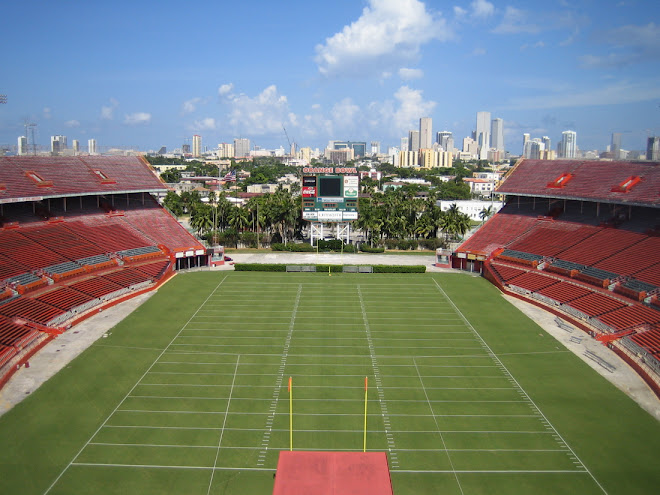
Sunday, February 20, 2011

Ghosts of the Orange Bowl: The Yamma Yamma Man


Jim Fleming, wearing the striped jacket, helps the cheerleaders fire up the Orange Bowl crowd in 1968. Fleming was more well known among Hurricane fans as "The Yamma Yamma Man"

Jim Fleming was the college student who never grew up. He was a cheerleader for the University of Miami while he was a student from 1964 to 1968. He had a rough, loud and booming voice who could incite any crowd into pandamonium. But when he graduated from college, it seemed he never left. Fleming was so popular among Canes fans and UM students, he became an institution on the Orange Bowl sidelines and was brought back to help lead the cheers for close to four decades. But few people knew him by name. He was more well-known simply by his nickname "The Yamma Yamma Man".

A native of Rochester, New York, Fleming was always short in stature. He attended an all-boys high school in Rochester, competing in track in cross country. But during football season he was a cheerleader. When he enrolled at the University of Miami, he immediately tried out for the squad and was an immediate sensation at Canes games at the Orange Bowl. He was instantly recognized for his unique cheers while screaming into the microphone.

"I got the reputation of being kind of a smart alec--a Jimmy Cagney character," said Fleming in an interview with writer Jim Martz. "I was Mickey Rooney with a chip on his shoulder. When John Routh was the Ibis, we matched so beautifully. We were both irreverent. My irreverance got me in trouble a lot of times".

During a game against Notre Dame in 1965, Fleming's cheers almost got him into a physical confrontation with Notre Dame coach Ara Parseghian. At the time, the student section sat behind the opponents bench and would taunt the opposing players much like a basketball game.

"We were obnoxious and it was a highly charged atmosphere," Fleming said. "We were doing a thing with the band screaming, 'Cheer up Ara, the worst is yet to come.' and saying 'Arrrra! Arrrra! By the third quarter, he'd had it. He came over to me and said something you can't print. He said, 'Listen you little SOB. Shut up!' He grabbed me by the throat a little. He was hot. His veins were popping. It shocked me. Somebody was trying to restrain Ara and cool him down. There were a number of cheers back then that would be banned today as people have become more politically correct."

As a kid, I can remember Fleming working the sidelines with his microphone in the 1980s. Some of his popular cheers included, "We've got some Canes over here! Woosh Woosh!". When the referees made what was considered a bad call, Fleming and the drum section of the band would lead the students in the chant "Hey, your momma!" It was a cheer that was eventually banned. When the Canes played the University of Florida, Fleming would scream, "Alligator bags, alligator shoes. If you're a Florida Gator, you're born to lose."

But Fleming didn't just scream into a microphone. In his younger days, he did all kinds of stunts and often paid the price. He dislocated both shoulders, ruptured an achilles, broke his clavicle and suffered a concussion.

"At the USC game in 1966, I was doing a flip and landed the wrong way and dislocated my shoulder falling over a cheerleader," Fleming said. "The USC doctor put it back in place in their locker room at halftime.

But Fleming's legacy at the University of Miami is more than just being a cheerleader. He was the president of the student body and founder of the campus radio station WVUM. But in March of 2006, Fleming died from a heart attack. He was 61 years old. Hurricane football games have never been the same since he left. I can safely say the Yamma Yamma Man was the ultimate University of Miami fan.

Saturday, February 19, 2011

Orange Bowl Snapshot: Wahoo McDaniel


November 6, 1966: Miami Dolphin player Wahoo McDaniel attempts a punt against the Buffalo Bills in the Orange Bowl. McDaniel was one of the few players in pro football history to wear his first name or nickname on the back of his jersey

Edward "Wahoo" McDaniel was one of pro wrestling's most colorful characters during the 1970s and 80s. A Choctaw-Chickasaw Native American, he would enter the ring in a traditional Indian headress complete with feathers. But before he gained fame as a wrestler, he was a journeyman profesional football player in the American Football League. He played nine seasons in the AFL with four different teams. Among his stops was Miami in 1966 , where he was a member of the first Miami Dolphins team. McDaniel was known as a wild character who loved to drink, party and raise a little hell. But one thing made him unique compared to other players. He was the only player who had his nickname or first name placed on the back of his jersey. Instead of reading "McDaniel", his jersey simply read "Wahoo". Many years later, WWE wrestling owner Vince McMahon Jr. would start a pro football league called the XFL. Many players had colorful names placed on their jerseys. The most memorable was Rod Smart whose jersey read "He Hate Me".

The 1966 Miami Dolphins were a collection of castoffs, misfits and unqualified rookies and their league worst 3-11 record was a reflection of that lack of talent. But among this group of characters was linebacker/punter Wahoo McDaniel. He was selected by the Dolphins in the expansion draft after being left unprotected by the New York Jets. McDaniel was a solid player in New York and once made 23 tackles in one game against Denver in 1964. During the offseason he began his pro wrestling career while working for Vince McMahon Sr. McDaniel, along with former Houston Oiler player Dory Funk Jr. were among low salaried football players who dabbled in wrestling. McDaniel and Funk would become longtime rivals and later legends in the wrestling business.

McDaniel got his nickname Wahoo from his father who was known as "Big Wahoo". Wahoo grew up in Midland, Texas and was an accomplished athlete. One of his high school baseball coaches was future President George H.W. Bush. McDaniel earned a football scholarship to the University of Oklahoma and played for legendary coach Bud Wilkinson. During his career at Oklahoma, he played in two Orange Bowl games with the Sooners on New Years Day of 1958 and 1959. Oklahoma won both times.

Wahoo McDaniel played three seasons with the Dolphins from 1966-68. But after an altercation where he knocked out two police officers, he was traded to the San Diego Chargers. McDaniel would never play a down in San Diego and quit football to pursue wrestling full time. For the next 20 plus years, he became one of pro wrestling's most iconic figures. His glory years were wrestling in the Mid Atlantic area staging many memorable matches with his peers Ric Flair, Harley Race and the Funk Brothers. But his health quickly declined in the mid 90s and eventually lost both kidneys. He died on April 18, 2002 from complications due to diabetes and renal failure. Wahoo McDaniel was 63 years old.

Friday, February 18, 2011

Orange Bowl Snapshot: Prince


April 7, 1985: The artist known as Prince performs at the Orange Bowl during the final show of his Purple Rain tour

During the spring of 1985, there wasn't a bigger music star in the world than the artist known as Prince. His landmark Purple Rain album had catapulted the eccentric musician to the top of the pop charts,eclipsing Michael Jackson. Not only was the album number one in sales at the time, he also starred in the movie "Purple Rain" which also did well at the box office.

At the very height of his career, Prince brought his band The Revolution to the Orange Bowl on April 7, 1985 for the final concert of his Purple Rain tour. The Orange Bowl was transformed into the "Purple Bowl". More than 55,000 people attended and they didn't leave disappointed. The opening act was percusionist/singer Sheila E., who was a Prince protoge and had a popular song on the pop charts "The Glamorous Life". Prince performed 22 songs that evening, including every song from the Purple Rain album. He closed his show appropriately with the album's title track.

The tour sold 1.7 million tickets according to Spin Magazine. It also marked the touring debut of his band The Revolution. The Orange Bowl performance would be Prince's only appearance at the legendary stadium. But it wouldn't be his last or most memorable South Florida concert. Nearly 22 years later, Prince performed at halftime of Super Bowl XLI at Dolphins Stadium (Now known as Sun Life Stadium).

Thursday, February 17, 2011

Orange Bowl Snapshot: Bennie Blades vs. Notre Dame 1985


November 30, 1985: Miami safety Bennie Blades returns an interception 61 yards for a touchdown against Notre Dame. Miami won 58-7


During the 1980s, the University of Miami Hurricanes were the bad boys of college football. But where did that reputation begin? If I had to pick one moment in a specific game, it would be Bennie Blades's pick six against Notre Dame in 1985.

At the time Blades was a young sophomore who was just beginning to make a name for himself as a college player. Notre Dame's program may have been at its lowest point. Gerry Faust was coaching his final game and the Irish entered with a 5-5 record. Late in the second quarter, Miami led 13-0 and was in control of the game. Notre Dame quarterback Steve Beuerlein fired a pass intended for running back Allen Pinkett. Blades cut in front of Pinkett, intercepted the pass and then used his sprinter's speed to easily cruise 61 yards to the end zone. As Blades returned the interception he slowed down and high-fived teammate Selwyn Brown before crossing the goal line.

By today's standards, that's not much of a big deal. Players celebrate all the time and this one was tame. But looking back, that play was the first sign of Miami "swagger" that I can remember witnessing. It also opened the floodgates as the Canes rolled to a 58-7 victory. CBS broadcasters Brent Musburger and former Notre Dame coach Ara Parseghian would voice their outrage over the lopsided score and accused Miami coach Jimmy Johnson of running it up.

Before that game, Miami didn't have much of a reputation other than upsetting Nebraska in the 1984 Orange Bowl and losing to Boston College on the famed "Hail Flutie" play. But this game forever changed Miami's image. Many like to look back at the Canes antics prior to the 1987 Fiesta Bowl against Penn State. But the 1985 Notre Dame game was when Miami became the villains of college football.

Tuesday, February 15, 2011

South Florida Legend: George Smith


The scowl. If you've ever seen or met St Thomas Aquinas High School football coach George Smith, you've experienced it. His facial expression rarely changes. Unless you really know Smith well, it's hard to tell whether he's happy or angry. He can be intimidating, sarcastic and sometimes even funny. The players change. But his face and his teams ability to win games rarely waivers. Smith is the epitome of consistency. His Aquinas Raiders have won 6 state championships, 7 runner-up finishes and 2 mythical national titles. But after 34 years of coaching and 361 career victories, we will no longer see Smith pace the sidelines in his trademark coach's shorts and scowl. He will step down as Aquinas head football coach, but will remain as the school's athletic director. Defensive coordinator Rocco Casullo will be Smith's replacement. It will be hard to imagine South Florida high school football without him.

George Smith never thought he'd be a coaching legend. In fact he never thought he'd be a head football coach. A native of Lafayette, Indiana and graduate of Purdue University, Smith moved to Fort Lauderdale and was originally hired by St. Thomas Aquinas to start the school's wrestling program in 1972. He spent 7 years coaching wrestling while also serving as an assistant football coach under then head coach Dave Franks. In 1975, Smith replaced Franks as head football coach and Broward County football would never be the same.

When Smith arrived at St. Thomas Aquinas, the school's athletic program was mostly known for Chris Evert's tennis exploits and the football team had yet to establish itself as a local power. Brian Piccolo, who graduated in 1961 back when the school as known as Central Catholic High School, was the most famous football alumnus at the time. Aquinas wasn't even considered the best Catholic school football program in Broward County, lagging behind rivals Cardinal Gibbons and Chaminade. That would change.

By the late 1970s St. Thomas Aquinas was starting to emerge as one of the best football programs in South Florida. Smith surrounded himself with quality assistants, many of whom have worked with him for decades or played for Smith. The success of Aquinas began to attract to players from all over Broward. These players included All American lineman Stefan Humphries and quarterback Mike Stanley, who later became a major league catcher for several years. By the early 1980s, Aquinas had eclipsed Hollywood Hills High School to become the predominant power of Broward County. Smith's 1981 Raiders, led by quarterback John Congemi, went undefeated during the regular season before losing to Suncoast High School of Riviera Beach in the state playoffs. It was the best finish in the history of the Aquinas program at that point. But the best was yet to come. Two years later, Aquinas went undefeated again. This time they were led by a big, cocky wide receiver named Michael Irvin. But again, Smith's quest for a state championship was dashed in the state playoffs by then Class 3A champion Titusville.

For all of Smith's success, it's hard to believe it took him 16 years to reach his first state championship game. That first title game appearance didn't go well. In 1991 Aquinas was crushed 39-14 by a Fort Walton Beach team led by future UF Heisman winner Danny Wuerffel. But after 17 years of frustration, Smith's finally got his first state championship ring in 1992 when Aquinas beat Tallahassee Leon 24-9 in Gainesville.

After finally winning it all, Smith called it quits after the 1992 season and remained as the school's athletic director. Mike Spencer took on the daunting task of replacing Smith. Spencer would quickly learn those big shoes were almost impossible to fill. Aquinas qualified for the state playoffs in 1993 and 1994, but were unable to maintain the program's dominance under Smith. Those two years being away from the sidelines were tough for Smith. He still had the competitive juices flowing and decided to return as head coach in 1995. From the that point on, Aquinas would be an almost regular participant in the 4A or 5A state championship games.

From 1996 through 2010, Aquinas reached the state title game a remarkable 11 times in 15 years. Five of those teams would leave with the championship trophy. But some of his best teams never won a title. During a 3-year stretch from 2004-2006, Aquinas lost to Lakeland each year including a double overtime heartbreaker in 2006 at Dolphin Stadium (Now Sun Life Stadium). Smith's 2009 team may have been his best ever. Aquinas was ranked #1 in the nation at the time by USA Today. But the Raiders were upset by Bradenton Manatee in the Class 5A semifinals. Smith's career would not end with a loss. The 2010 team would rebound and defeat Tampa Plant in the 5A state finals, giving Smith his 6th and final state title. It would be his last game..

George Smith leaves an enormous legacy and void in local high school football and Broward County athletics. Not only was he a great football coach, he also developed the most successful complete athletic program in South Florida as the school's athletic director. St. Thomas Aquinas has won or challenged for state titles in just about every varsity sport. The school's athletic program has won the Miami Herald's Broward County All Sports Award every year for over 20 years running.

He has a huge amount of admirers and critics. Many claim Aquinas has an unfair advantage over most of its competition.. Good or bad, St. Thomas Aquinas is a private school that has the ability to draw students throughout South Florida. In a few cases, there have been athletes who've moved to South Florida from out of state or from other parts of Florida just to be a part of Smith's program. One notable example was when former Miami Southwest High defensive back Lamarcus Joyner transferred to play for Aquinas during his senior year. While I can't prove St. Thomas Aquinas recruits athletes from other schools, there's no doubt talented kids want to be a part of that program. Under Smith, hundreds of his former players have gone on to college and have become successful in various fields. During his induction into the Pro Football Hall of Fame, Michael Irvin went out of his way to mention Smith in his speech and the impact he had on Irvin's life as a coach and mentor. No matter what your opinion may be of George Smith, there is no doubt there will never be another one like him.

George Smith by the numbers:

Career Record: 361-66

State Championships: 1992, 1997, 1999, 2007, 2008, 2010

National Championships: 2008, 2010

Undefeated Regular Seasons: 1981, 1983, 1986, 1991, 1992, 2000, 2001, 2005, 2008, 2010


Notable Former Players:

Tony Brown - Class of 00
Wes Byrum - Class of 07
Greg Cox - Class of 84
Duron Carter - Class of 09
John Congemi - Class of 82
Tavares Gooden - Class of 03
Leonard Hankerson - Class of 07
Stefan Humphries - Class of 84
Michael Irvin - Class of 84
Lamarcus Joyner - Class of
Sterling Palmer - Class of 89
Daryl Porter - Class of 93
Twan Russell - Class of 92
Nate Salley - Class of 02
Tony Sands - Class of 88
Terry Smith - Class of 93
Mike Stanley - Class of 81
Slip Watkins - Class of 86
James White - Class of 10
Major Wright - Class of 07
Sam Young - Class of 06

Wednesday, September 2, 2009

Ghosts of the Orange Bowl: Jim O'Brien


Jim O'Brien might be the most unlikely Super Bowl hero who ever played. In 1970, the long-haired rookie kicker for the Baltimore Colts was just hoping to play in the NFL. He was a 3rd round draft pick from the University of Cincinnati and most football fans outside of Baltimore had never heard of him. But on January 17, 1971 in the Orange Bowl, O'Brien forever etched his name in Super Bowl history. He would kick a field goal in the final seconds to win Super Bowl V.

The 1970 football season was the first following the NFL-AFL merger. The first four Super Bowls matched up the champions from the NFL and the AFL. Both the Dallas Cowboys and the Baltimore Colts were established NFL powers. The Colts were among three NFL franchises that joined the new American Football Conference that was primarily made up of teams from the old AFL. The Cowboys were the champions of the National Football Conference. Super Bowl V established several firsts in the history of the big game. It was the first Super Bowl played on artificial turf. It was also the first Super Bowl in which the MVP (Dallas linebacker Chuck Howley) was a defensive player and also played for the losing team.

Super Bowl V featured some of football's greatest players including hall of famers Johnny Unitas, John Mackey, Ted Hendricks, Mike Ditka, Bob Lilly and Bob Hayes. But it was also one of the most poorly played Super Bowls of all time. The game was often referred to as "The Blunder Bowl" or "Stupor Bowl" Both teams combined for a record 11 turnovers, including 7 by the Colts who were the winning team. Dallas committed a Super Bowl record 10 penalties for 133 yards. But the most enduring image of the game was Jim O'Brien's 32-yard field goal with 5 seconds remaining in the game to give the Colts a 16-13 victory.

In a game that was filled with turnovers and mistakes, it was only fitting O'Brien's game winning field goal was set up by a Dallas interception. With less than a minute remaining in the game and the score tied 13-13, Cowboys quarterback Craig Morton threw a pass intended for running back Dan Reeves. The pass was high and bounced off Reeves's fingertips and fell into the arms of Colts linebacker Mike Curtis who returned the ball to the Dallas 32 yard line.

With only five seconds left on the clock, all eyes turned to Colts kicker Jim O'Brien. The rookie was under incredible pressure. O'Brien was an old-school straight-on style kicker, as opposed to today's kickers who all kick soccer-styled from the side of their foot. O'Brien was also one of the last of his era, who wasn't just a kicking specialist. He was also a wide receiver and wore #80. But if he was nervous, he never let anyone know he was scared.

"I always pretended that every field goal was the last second of a championship game," O'Brien said. "I wasn't the greatest kicker and I never pretended to be. I never told anybody I was. Whenever we needed a kick, I made it. I never missed a kick that would have won a game."

Colts quarterback Earl Morrall took the snap, placed the ball perfectly and O'Brien drilled the ball through the uprights of the Orange Bowl's east end zone. The Colts won their only Super Bowl as the Baltimore Colts.

"I knew that it was going to be good," O'Brien said. "It probably could have gone 55 yards. It was the best kick of my life and I was very fortunate to be in that spot and to be successful."

Jim O'Brien played only four seasons in the NFL. He was a decent to average kicker at best and also caught 14 passes as a backup receiver including 2 touchdowns in his career. He is not the only kicker to have the opportunity to win a Super Bowl. Twenty years after O'Brien's game winning field goal, Buffalo's Scott Norwood tried to duplicate O'Brien's heroics in Super Bowl XXV. But Norwood's 47-yard attempt fell wide right. O'Brien's distinction for being the only player to kick the game winning field goal in the Super Bowl finally ended when New England's Adam Vinatieri made the winning kick to beat the St. Louis Rams in Super Bowl XXXVI. Vinatieri did it again two years later to beat the Carolina Panthers in Super Bowl XXXVII.

Tuesday, September 1, 2009

Ghosts of the Orange Bowl: Mercury Morris


Former Miami Dolphins running back Eugene Morris was so quick on his feet, it was only appopriate he was nicknamed after the Greek god of speed--Mercury. When he scored, he didn't just settle for one yard runs or dives over the goal line. Morris preferred to cruise 40, 50, 60 and sometimes 70 yards past defensive players and leaving them in the dust. He ran fast on the field and he lived just as fast off it. Soon his life spun completely out of control and crashed with cocaine addiction. But just as he overcame the label of a "bust" after he was drafted, he beat his drug habits as well.

Eugene Morris was born and raised in Pittsburgh. He was always athletic, talkative and cocky. He was a standout high school basketball and football star at Avonworth High School. Academically he was a bit of an underachiever. He was intelligent, but didn't necessary apply himself in the classroom. His grades were average, but his athletic ability certainly wasn't. After graduation he took his talents to West Texas State University, now known as West Texas A&M University.

Morris first made a name for himself by putting up huge numbers at the small Texas college. He and USC's O.J. Simpson were the most prolific college runners of the day. During his junior year in 1967, Morris rushed for 1,274 yards and finished second in the nation behind Simpson. In 1968, Morris set college records with 340 yards rushing in one game, 1,571 in one season and 3,388 yards for his career. Unfortunatley for Morris, Simpson broke Morris's single-season rushing record. Simpson also had the advantage of playing for national power USC and easily won the Heisman Trophy. Morris was a small college phenom whose name was on top of the NCAA rushing statistics but was an unknown to most college football fans. But he was no secret to pro scouts.

During his career at West Texas State, Morris earned the nickname "Mercury" for his blazing speed and great breakaway runs. When his college career ended, he was invited to play in the North vs. South Shrine Game at the Orange Bowl. The North vs. South Shrine Game featured many of the top college seniors in the nation. For the first time, Morris got the opportunity to play and prove himself against athletes from bigger schools. But Morris struggled in his few carries and lost a fumble. He was still highly regarded by the pro scouts. But his draft stock slipped and he was picked in the 3rd round by the Miami Dolphins in 1969 NFL/AFL common draft.

When Morris arrived in Miami in 1969, the Dolphins were a struggling 3-year-old AFL franchise. George Wilson was in his final year as the team's head coach and there was a culture of losing. But while the Dolphins weren't winning many games, they were stockpiling a growing group of young, talented players. These young prospects included quarterback Bob Griese, running backs Larry Csonka and Jim Kiick, receiver Howard Twilley, defensive linemen Bill Stanfill and Manny Fernandez and defensive back Dick Anderson. This young core of players would later realize their potential under their next head coach Don Shula.

From the time Shula was hired by owner Joe Robbie to replace Wilson, the Miami Dolphins became South Florida's flagship franchise. They were the only pro team in town and they would no longer take a back seat to the University of Miami or local high school football. Miami became a Dolphins town. During Shula's first season as Dolphins head coach in 1970, Miami finished 10-4 and made the playoffs. Shula had brought a team-first mentality and discipline to a group of players who were talented but needed the right leadership. Most of the players bought into Shula's philosophy. But Mercury Morris wasn't one of them.

Morris found himself playing very little and backed up Jim Kiick at tailback. He was used to being the star of every team he played for and his ego demanded the same treatment with the Dolphins. But he needed an attitude adjustment. The Dolphins were emerging as one of the best teams in football and Morris felt left out. In 1970, he only carried the ball only 60 times the entire season, while the team clinched its first playoff appearance in franchise history. In 1971, Morris carried only 57 times and it appeared he was a huge draft bust. The Dolphins made it to Super Bowl VI, losing to the Dallas Cowboys 24-3. Miami was led by its punishing backfield of Larry Csonka and Jim Kiick. While Csonka and Kiick were the most productive tandem of running backs in the NFL at the time, Super Bowl VI exposed a weakness amongst Miami's biggest strength. The team lacked a home run threat in the backfield. Csonka was power runner who gashed through defenses, often running over and trampling tacklers. Kiick was known for his versatility as both a runner and receiver and was money on goal line and short yardage situations. But neither Kiick nor Csonka had the speed to break big runs. The loss in Super Bowl VI opened the door for Morris. Mercury Morris never touched the ball from scimmage in the game and he vented his frustration.

"A reporter came up to me after the game and said, 'Hey Mercury, is there something wrong?'" Morris said. "I said yes, something's wrong. I didn't play in this game. The only time I was off the bench, except for the kickoffs, was for the national anthem."

Shula was concerned with Morris's attitude and discipline. But he never questioned his talent. In 1971, Morris averaged 5.8 yards per carry, the best on the team. Shula decided to increase Morris's role on the team for the 1972 season. He began rotating Morris and Kiick at the tailback position. Morris played so well, it became almost impossible for Shula to take him out. Soon, Morris had replaced Kiick as the leading tailback. The move could have completely destroyed team chemistry. Kiick and Csonka were the best of friends and were often inseparable. They were nicknamed "Butch and Sundance" and once did a promotional poster wearing cowboy outfits and riding horses. But both understood the promotion of Morris to starting tailback made the team better.

Morris made an immediate impact once he was inserted into the starting lineup. He rushed for exactly 1,000 yards, scored 12 touchdowns and averaged 5.3 yards per carry. His galloping running style was perfect for the Orange Bowl's artificial turf. He often made violent cuts, faking out defenders and then darting past them. When he reached the end zone, he would often end his touchdown runs with a thunderous spike of the football. Morris and Larry Csonka became the first pair of running backs from the same team to rush for at least 1,000 yards in the same season. The Dolphins went from a good team to a great team--perhaps the greatest of all time. Miami finished the season undefeated and went on to beat the Washington Redskins 14-7 in Super Bowl VII. Morris was selected to the Pro Bowl and once again, found himself compared with Buffalo's O.J. Simpson as football's fastest running backs.

In 1973, Morris continued to make big plays from the backfield. He carried the ball 41 fewer times than in 1972, but he was more efficient. Morris rushed for 954 yards and averaged a remarkable 6.4 yards per carry, the best in the NFL. He made the Pro Bowl again and Dolphins went 12-2 and went on to beat the Minnesota Vikings in Super Bowl VIII. It would be the last time the Miami Dolphins would rule pro football. It was also the last time, Morris would enjoy great individual success.

Morris's career began to decline in 1974. Injuries were beginning to take a toll and he played only five games in the 1974 season. Csonka, Kiick and wide receiver Paul Warfield would leave the Dolphins for the World Football League and the Miami dynasty was over. Off the field, Morris's life began to spiral out of control. He began using drugs, particularly cocaine. His play also began to suffer. In 1975, he played his final season with the Dolphins, rushing for 875 yards, but his average per carry was a career-low 4.0. Morris finished his NFL career with the San Diego Chargers in 1976 and carried the ball just 50 times for 256 yards.

With his football career over, Morris's drug use became a bigger problem. He not only used cocaine, he also was trafficking it. In 1982, his life hit rock bottom. He was sentenced to 20 years in prison, with a mandatory 15 year term. But on March 6, 1986, his conviction was overturned by the Florida Supreme Court due to evidence Morris had been unable to prove entrapment based on excluded evidence that was mistakenly characterized as hearsay. He was given a re-trial and reached a plea agreement. Morris was released from prison on 23, 1986. He had been given a new lease on life and he wasn't about to throw it away.

Morris always had the gift of gab. He was charasmatic, articulate and very likeable. He would use those skills as a motivational speaker and began preaching to young people about the dangers of drugs. Over the years, he's shared his story with thousands of people.

"I'm happy that things turned out the way they did in my life," Morris said. "And I'm thankful, as I look back, for every single circumstance that I've gone through because it's enabled me to learn something about myself and about what teammates are and about who people are."

Morris has remained close with his former Dolphin teammates and can be seen at just about every reunion.

"Eugene has grown immensley in the years since we've been playing together," said former Dolphin offensive lineman Bob Kuechenberg. "He made some mistakes that a lot of young people make and he got caught and got into a lot of trouble for it and he paid the price for it. I really enjoy my relationship with Eugene Morris nowadays. He's a pleasure to be with---a very bright fellow, very articulate and just a lot of fun."