Sunday, June 19, 2011

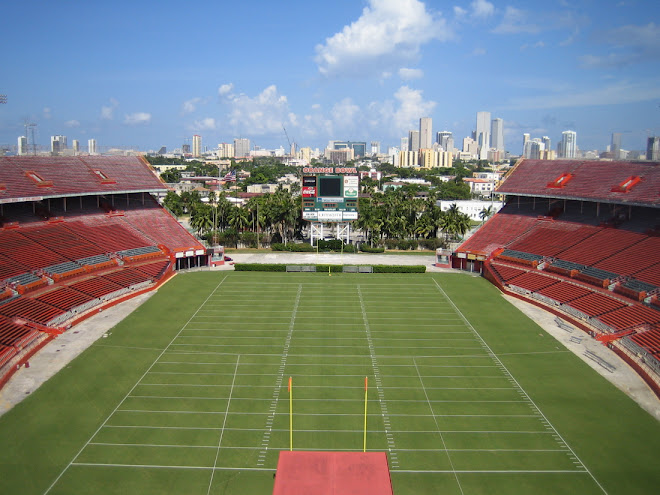
Orange Bowl Snapshot: Burdine Stadium


The Orange Bowl Stadium pictured in the early 1940s

When the Orange Bowl Stadium opened in 1937, it was originally named Roddy Burdine Stadium. Burdine was one of the city's great economic figures of the early 20th century and was the head of the Burdine's department store chain. His father William Burdine founded Burdine's as a dry goods store in 1898. Roddy Burdine had been a big supporter of Miami's growing sports scene in the 1930s. He was one of the leading advocates to build a football stadium for the newly born Orange Bowl Committee headed by Ernie Seiler.

Unfortunately, Burdine passed away in 1936, one year before the stadium was completed. As a tribute to Burdine, the City of Miami passed a resolution to name the facility after the late merchant. The stadium originally seated 23,330 costing just $340,000 in construction. Although the stadium was officially called Burdine Stadium, most fans and members of the media referred to it as simply the Orange Bowl.

Over the next couple of decades, the stadium would expand in size. In 1948, Burdine Stadium added an upper deck. By 1959, the stadium's official name was changed to the Orange Bowl.

Friday, June 17, 2011

Orange Bowl Snapshot: Pete Banaszak


November 20, 1964: University of Miami fullback Pete Banaszak gains yardage during Miami's 35-17 homecoming victory over Vanderbilt.

A native of Crivitz, Wisconsin, Pete Banaszak came to Miami after being recruited by former longtime Hurricane assistant coach and fellow Wisconsin native Walt Kichefski. A physical and bruising runner with good hands and blocking skills, Banaszak lettered at UM from 1963-65 and led the Canes in rushing as a sophomore and senior while teaming in the same backfield with fellow running back Russell Smith.

Banaszak went on to a long and outstanding pro career with the Oakland Raiders from 1966 to 1978. He returned to the Orange Bowl several times as a member of the Raiders. Banaszak made his pro debut against the Miami Dolphins on September 2, 1966. It also happened to be the first game in Dolphins history. The Raiders would win 23-14.

More than a year later, Banaszak was one of four former University of Miami players on the Raiders roster which won the AFL title and played the Green Bay Packers in Super Bowl II at the Orange Bowl. (Jim Otto, Bill Miller and Dan Conners were the other three former Canes on the 1967 Oakland roster) The Raiders were overmatched by the veteran Green Bay dynasty and lost 33-14. It would be the last game of Vince Lombardi's legendary coaching career with the Packers.

The Raiders were the NFL's winningest team of the 1970s and were consistent Super Bowl contenders. But it took 9 long years for Banaszak to get back to football's biggest stage. Oakland lost 4 AFC championship games, including 1973 to the Dolphins at the Orange Bowl. But in 1976, Banaszak and the Raiders finally got their ring, beating the Vikings in Super Bowl XI. He scored a pair of touchdowns on short runs near the goal line in Oakland's 32-14 victory.

Banaszak was extremely dependable at the goal line and short yardage situations. He led the NFL with 16 touchdowns in 1975. Banaszak finished his career with 3,772 yards rushing, 1,022 yards receiving and 52 total touchdowns in 173 games.

Thursday, June 16, 2011

Orange Bowl Snapshot: Miami High vs. Coral Gables 1966


November 10, 1966: Coral Gables High School fullback Tom Bailey grabs a 37 yard touchdown pass from quarterback Craig Curry against Miami High. The Cavaliers beat the Stingarees 20-7, ending Miami High's 20 game win streak in front of 11,445 fans at the Orange Bowl.The victory was sweet revenge for Gables, which saw its 28 game win streak snapped by Miami High the previous season. Bailey would go on to play his college football at Florida State University and played four seasons (1971-74) with the Philadelphia Eagles. Bailey died in 2005. He was 56.

Thursday, March 3, 2011

Orange Bowl Snapshot:: 1950 Homecoming


November 24, 1950: Members of the University of Miami's homecoming court were among the 45,000 fans who watched the Canes beat Iowa 14-6.

Over the years, I've collected many photographs of the Orange Bowl Stadium from surfing the net. This picture was taken during the University of Miami's homecoming football game against Iowa back in 1950. After doing a little research, this game was historically significant. Yet few people know about it.

Miami in 1950, like much of the South, was a segregated city. There were strict Jim Crow laws that prohibited blacks and whites from gathering and participating at the same functions. But on November 24, 1950, something new happened for the first time in the Orange Bowl Stadium. White and black athletes would compete on the same field.

The University of Iowa brought its football team to Miami to play the Hurricanes. At the time, Iowa had five African-American players on its roster. The University of Miami remained all-white. According to the University of Miami football media guide, UM had canceled games in the past against schools with black athletes. Games against Penn State and UCLA were specifically canceled in the 1940s. The UCLA cancellation was noteworthy because one of its African-American players happened to be Jackie Robinson--the same Jackie Robinson who later broke Major League Baseball's color barrier.

But in 1950, the University of Miami finally began to relax its segregational policies. Black fans were allowed to watch games at the Orange Bowl. But they were designated to only certain areas of the stadium--including the east end zone. The Hurricanes would beat Iowa 14-6 that evening. But late in the fourth quarter, one of Iowa's black players, sophomore halfback Bernie Bennett, scored a touchdown for the Hawkeyes. He happened to score in the east end zone, where a jubilant group of black spectators erupted in cheers.

"We were aware that we were setting a precedent," Bennett recalled. "But nothing happened during the game that reflected any conflict. There was no special security and there was no racist remarks. Once the game started, we just played."

While the game was played without any negative incidents or taunting, the trip to Miami wasn't routine. Bennett and his fellow black teammates were forced to stay in a separate hotel in the black section of town. Miami still had a long way to go at the time. It would be another 17 years before receiver Ray Bellamy would become Miami's first black football player.

Tuesday, March 1, 2011

Orange Bowl Snapshot: Howard Schnellenberger


January 2, 1984: University of Miami head coach Howard Schnellenberger gives his team a pep talk in the locker room before taking the field against Nebraska. The Hurricanes were a two-touchdown underdog against the top ranked Huskers who averaged 52 points per game during the regular season. Miami would beat Nebraska 31-30 to win its first national championship.

Saturday, February 26, 2011

South Florida Legend: Derrick Thomas


Hall of fame linebacker Derrick Thomas pictured as a senior at South Miami High School in 1984

Derrick Thomas was one of the most fierce pass rushers to ever play the game of football. He terrorized NFL quarterbacks for 11 seasons with the Kansas City Chiefs from 1989 to 1999. But it's hard to believe Thomas wasn't considered the best linebacker on his high school team. When college recruiters visited South Miami High School during the 1984-85 school year, Thomas was considered a talented and raw prospect. But his teammate Keith Carter was hailed by recruiting experts as a complete and finished product ready for college. Thomas went on to stardom as an All American linebacker at the University of Alabama before playing for the Chiefs. Carter would go on to a decent college career at Florida State, but never had near the success as Thomas.

Born and raised in Miami's West Perrine section, Derrick Thomas didn't seem destined for greatness on the football field. He was more likely to end up in jail than the hall of fame. His father Robert Thomas was a B-52 fighter pilot in the Vietnam War, who was killed in action. Growing up without a dad, Thomas didn't have many positive male role models in his life. He hung out with a bad crowd and often got into trouble. He was arrested several times as a youngster. By age 14, he seemed like a lost cause. He was sentenced to juvenile hall. But it was there where he found his true calling.

Judge William Gladstone recommended Thomas to be sent to the Dade Marine Institute (DMI), an alternative day school for troubled youngsters. It was at DMI Thomas met director Nick Millar, one of several mentors who helped Thomas get his life on track. Millar was a former college wrestler and recognized Thomas's athletic gifts. Thomas spent two years at DMI and was a model student. He channeled his energy towards his passion--athletics. His next goal was to play football for South Miami High School.

Thomas enrolled at South Miami prior to his junior year of high school. Head football coach Sam Miller didn't know much about Thomas at the time. But it didn't take long to notice his startling speed and size. Thomas played running back at tight end his junior year and scored a few touchdowns. But Miller realized Thomas's aggresiveness and physical nature was better suited for the defensive side of the football. He played outside linebacker and rush end, quickly gaining attention from college recruiters. He earned second-team All Dade County honors from the Miami Herald and Miami News. But his teammate Keith Carter was considered the big-name star on the team. Carter was selected to every high school All American team in existence including Parade Magazine, Scholastic Coach Magazine and USA Today. The Miami Herald rated Carter as the second best player in Dade County for the Class of 1985, behind Michael Timpson of Hialeah Miami Lakes.

But while Keith Carter was getting all the headlines and attention from recruiters, Thomas wasn't a complete unknown. He competed in football, wrestling, basketball and track at South Miami and was a standout in every sport. He actually gained more recognition as a wrestler--earning All Dade honors. The Miami Herald ranked him among Dade's 10 best senior prospects and several colleges were showing interest. In the end, he decided to attend the University of Alabama coached at that time by Ray Perkins. From the time he arrived in Tuscaloosa, Alabama, Thomas dominated and got better and better. He saw action as a true freshman. But once again, he found himself in the shadow of another linebacker teammate-- Cornelius Bennett. But when Bennett graduated in 1987, Thomas had the spotlight to himself for his final two years of college and never looked back. He became the most feared player in college football. Thomas was so quick off the ball, he literally was in the backfield once the ball was snapped. By his senior year he racked up an amazing 27 sacks and won the Butkus Award, given annually to college football's best linebacker.

Thomas was the 4th overall selection in the first round by the Kansas City Chiefs in the 1989 NFL Draft and he didn't disappoint. He was named the NFL's Defensive Rookie of the Year in 1989 and went on to become a 9-time Pro Bowl selection. Off the field, Thomas also made his mark. He never forgot his troubled past or the people who helped him turn his life around. This time Thomas decided he wanted to help kids realize the importance of eduacation. He established the Third and Long Foundation, which helps children with their reading skills. Thomas had suffered from reading disabilities when he was a kid. In 1993, Thomas was honored by the NFL and was given the prestigious Walter Payton Man of the Year award.

On January 8, 2000, Derrick Thomas' SUV went off the road as he and two friends were driving to Kansas City Airport, where they were going to fly to St. Louis to watch the NFC Championship game. Not wearing seat belts, Thomas and one of his passengers was thrown from the car. The first passenger was killed instantly while the second passenger, who was wearing his seat belt, walked away from the scene uninjured. Thomas was left paralyzed from the chest down. Derrick was later flown back to Miami to be treated by renowned Neurological Surgeon Dr. Barth Green at the University of Miami Miller School of Medicine. Despite receiving the best state-of-the-art paralysis care, Derrick succumbed to his injuries on February 8, 2000, after suffering a pulmonary embolism. Derrick Thomas was 33 years old.

Derrick Thomas left behind a huge legacy. He was elected to the Pro Football Hall of Fame in 2009. His son Derrick Jr. gave his inductment speech. Thomas' mother, Edith Morgan, established the Moms2Moms58 to honor his legacy. The foundation works with professional football players, non-profit organizations, community leaders, political figures and entertainers to educate the public on car seat and seatbelt safety, children's health and sports safety outreach to inner-city youth. Each year Moms2Moms58 hosts the "Celebration of Life Celebrity Weekend" in Derrick's hometown of Miami. On September 2, 2002, the Derrick Thomas Academy, a charter school, opened. It currently has an enrollment of 950 children from kindergarten to eighth grade.

Wednesday, February 23, 2011

Orange Bowl Snapshot: 1969 Orange Bowl


January 1, 1969: A view of the Orange Bowl stadium taken from the northwest stands during Penn State's 15-14 victory over Kansas. Penn State won in dramatic fashion when halfback Bob Campbell scored on a 2-point conversion with only 15 seconds left in the game. Campbell's score was a mulligan. Penn State had been stopped on its first try for a 2-point conversion. However, Kansas was penalized for having 12 men on the field. Penn State finished the season undefeated and finished #2 behind Ohio State in the final AP Poll.